In ancient times, those who understood complex patterns and numerical relationships, such as astronomers and mathematicians, were often viewed with a sense of awe, almost as if they possessed magical powers. This is because they could predict events like eclipses or solve problems that seemed mysterious or incomprehensible to others. Not much has changed and those who understand mathematics and statistics still have the edge. Throughout history, mathematics has often been associated with the mystical or magical because of its ability to describe the natural world with precision and predictability.
At SPYGLASS I do not provide financial planning solutions, rather I provide custom made spreadsheets, coaching as well as software as a service (SaaS) and educational material. My MBA was structured around quantitative subjects such as statistics and linear programming. My PhD prepared me for advanced mathematical modeling. From these learnings and experiences I’m able to steer you in the right direction based on scientific principles. Some of the advanced topics I include in predictive modeling are:
- Statistical inference of financial and economic data.
- Advanced Excel spreadsheets that are integrated with software such as python and VBA.
- Advanced integration of mathematics in finance and economics including:
- Time series analysis
- Nearest neighbor algorithmic searches.
- Regression analysis.
- Monte Carlo simulations.
- Markov modeling.
- Fuzzy logic modeling.
The techniques discussed here are not exhaustive but represent some of the most often used. Of course, we all would like to get a hint of what the future will bring. This is where mathematics and science separates from magic. Instead of a crystal ball, trends and underlying correlations in data are used to give a glimpse into a possible future.

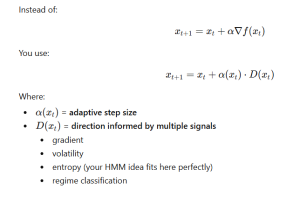
Adaptive Step Technology is a dynamic optimisation approach that adjusts both the size and direction of each step a model takes as it navigates complex solution spaces, such as financial markets or multi-variable decision environments. Unlike traditional methods that move in fixed increments, this approach continuously responds to underlying conditions—taking smaller, more cautious steps in volatile or uncertain regions, and larger, more decisive steps when the path is clearer and more stable. Conceptually, it acts like an intelligent “decision field” that senses the surrounding landscape—capturing gradients, curvature, and variability—and adapts its behaviour in real time. The result is a more efficient and responsive exploration process that not only seeks optimal outcomes but also adapts how it searches for them, enabling better performance in dynamic, real-world scenarios where conditions are constantly changing. Below is a bit of a glimpse into the mathematics behind the optimization.